Project 21 of 36
Dispenser
- Year
- 2019
- Discipline
- Product
- Images
- 4
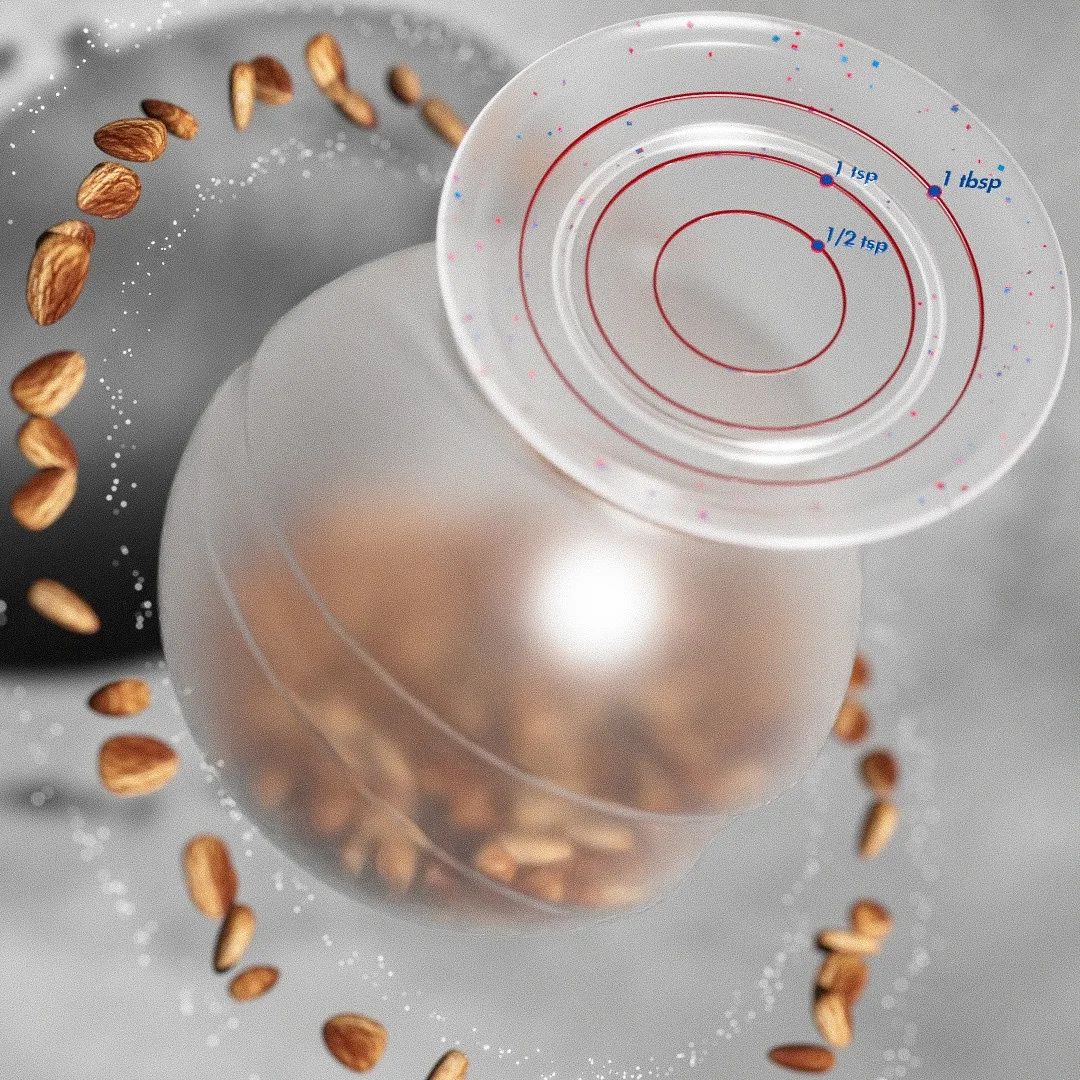
A dispenser for people living with restricted use of an upper limb. The project started with interviews about everyday routines, and a rose, thorn, bud synthesis that kept coming back to independence. The result is easy to use, with motion and voice activation, a plunger that dispenses liquids of any viscosity, and the option of a delivery service for refills.
Overview
- Objective
Understand the everyday problems of people with a restricted upper limb, and find a solution for them.
- Design response
A plunger dispenses liquids of any viscosity with ease, then retracts at the end of a reservoir's life so it can be swapped quickly.
- Compact storage
Disassembly is as easy as pulling apart the o-rings that hold it together. For travel, users bring just the body and buy reservoirs locally, combining a whole host of soaps in one dispenser.
- Key features
Motion sensor. Voice activation. Convenient refills, with an optional delivery service.
- Materials
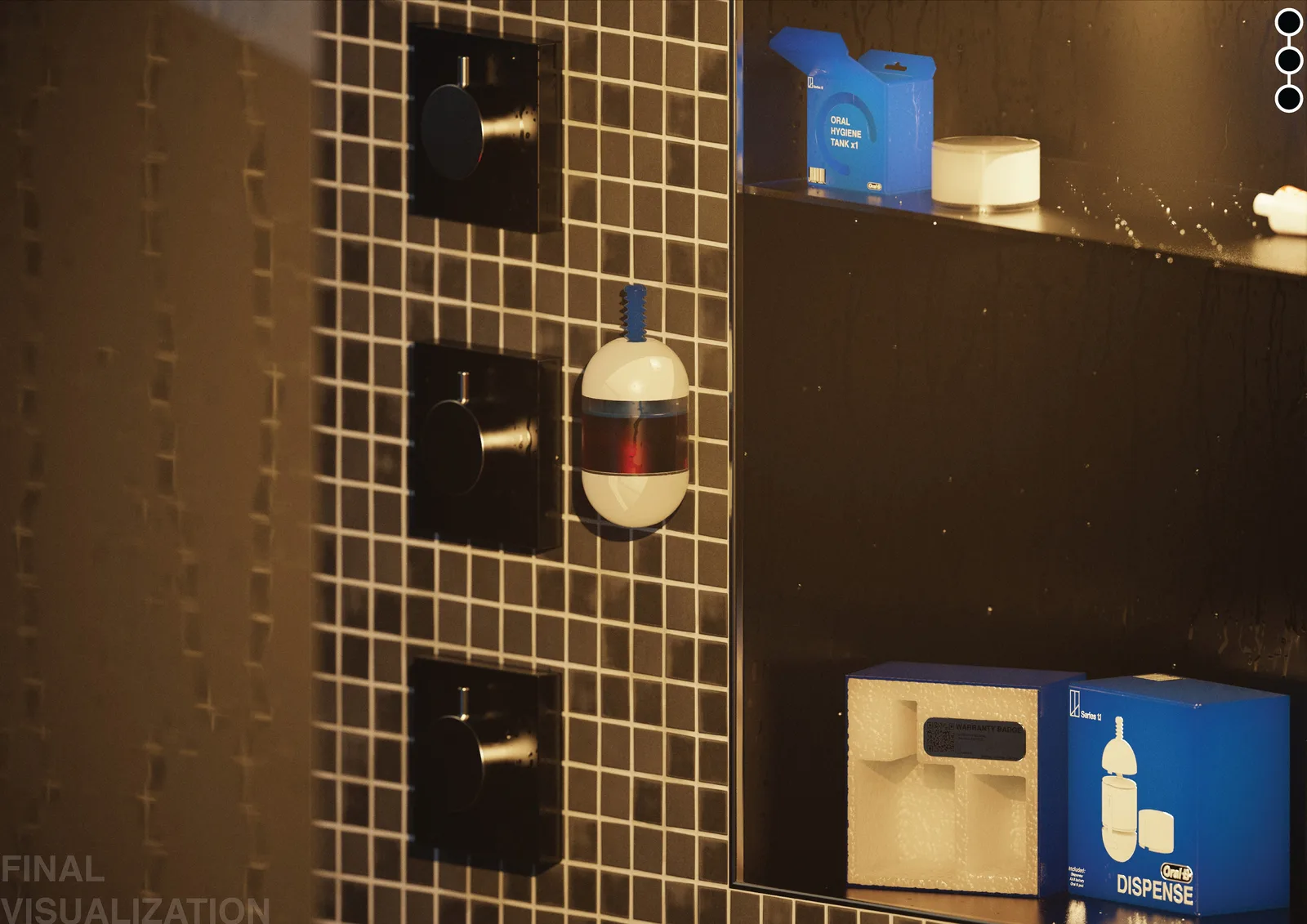
PLA (polylactic acid) for the dispenser: derived from renewable resources like sugar cane, biodegradable, low-shrinkage and insoluble in water, and best recycled at end of life. EPS (expanded polystyrene) for the packaging: cost-effective, recyclable, strong, and doesn't decay or harbor bacteria.
Design language
Accessible design without looking like assistive equipment: soft, friendly forms that anyone would want in their bathroom.
- Form
Rounded, egg-like modules that stack apart at o-rings, with nothing to grip or squeeze.
- Interaction
Hands-free by default, with motion and voice, so the object asks nothing of the hand that's limited.
- Color
Clean white bodies with bright blue packaging and accents: hygienic, calm and legible.
- Packaging
A family of blue boxes, with a reservoir pack sized like a consumable, so refilling feels like restocking toothpaste, not servicing a device.
My role
Stakeholders I coordinated
- Who helps
- Parents, with every daily task · Siblings · Roommates · Friends · Strangers, only with opening packages
- Where help is needed
- Cooking · Chores · Opening packaging · Bathroom routines · Getting dressed
Research
Four interviews with people living with limited use of one arm mapped where the day gets hard. The morning routine came up again and again. A rose, thorn, bud synthesis then sorted what they valued, what hurt and what could grow, and pointed at independence as the need to design for. Names are withheld.
Interviews
What each participant lives with, and where daily life gets hard.
| Participant | Limitation | Daily challenges |
|---|---|---|
| 1 | Loss of right lower-arm mobility | Operating a computer, sports, preparing food, carrying laundry, the morning routine (showering, brushing teeth) |
| 2 | Loss of left lower-arm mobility | Repeated breaks over time, severe pain, couldn't work, bathe for long periods or exercise; brushing teeth |
| 3 | No left-hand mobility | Opening doors and packages; the morning routine (brushing teeth, washing hair) |
| 4 | Loss of mobility in dominant arm | Getting changed, writing, seatbelts, relearning to brush teeth with the other hand, needing help with hair; the morning routine is exhausting |
Rose, thorn, bud
The last column is what stood out most in each row.
| Observations | Strongest signal | |
|---|---|---|
| Rose | New ways of doing things, a new community, closer to those who help, more attention | Constantly looked after |
| Thorn | Relearning with help, being labeled, less privacy, less time alone | Less independence |
| Bud | Expanded creativity, a new sense of purpose, building relationships, new chances to be recognized | Appreciates time alone |
Gallery